
On our way back east, we visited several sites that were thought provoking and inspired us to reflect on how far we’ve come as a country, and how far we still need to go.
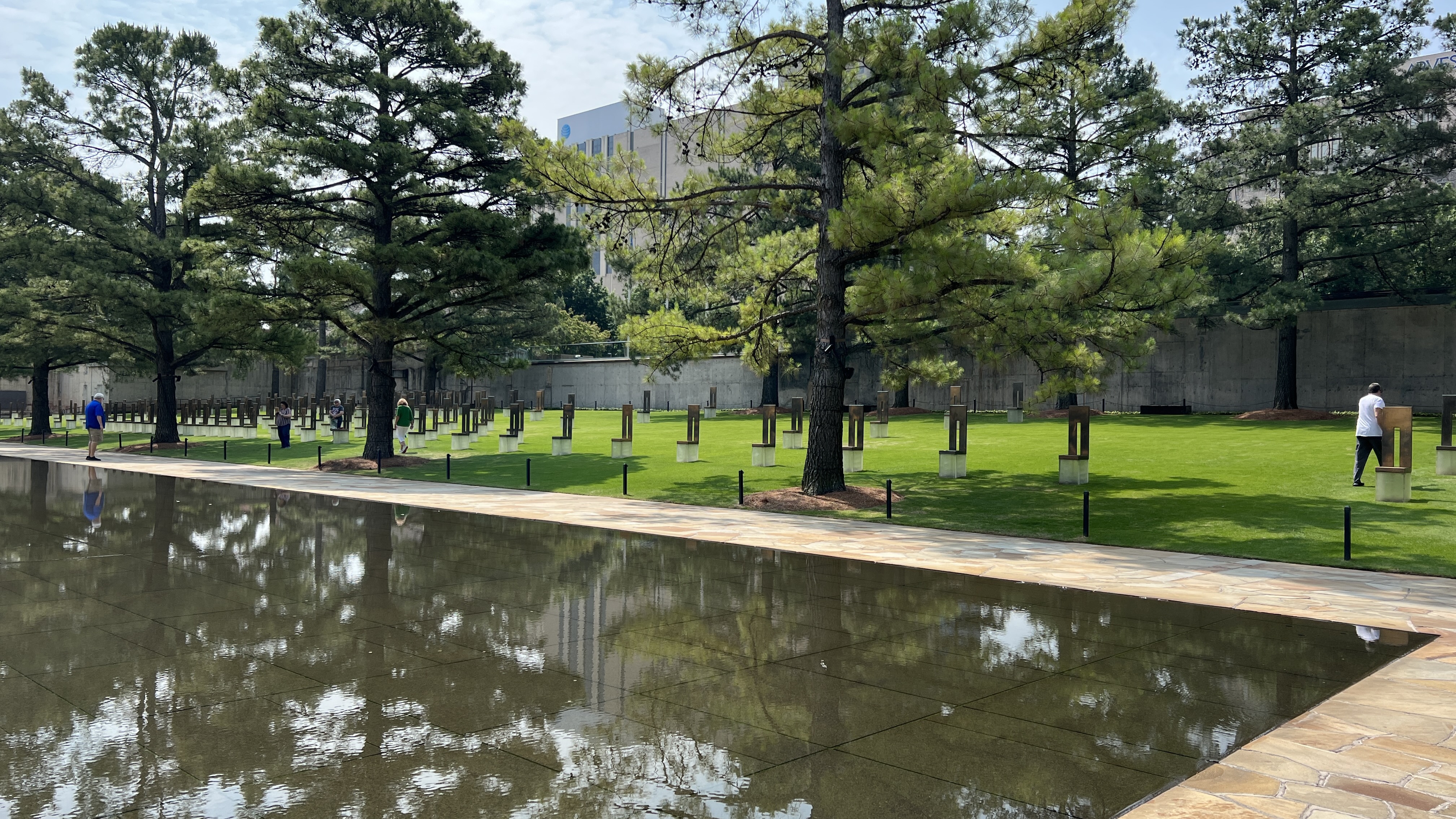
- Deadliest Attack of Domestic Terror in the U.S: At 9:02am on April 19, 1995, the Alfred P. Murrah Federal Building in Oklahoma City, Oklahoma, which also housed a day-care center, was the target of a right-wing, domestic terrorist bombing. 168 people died—including 19 children—and 680 people were injured. This is known as the Oklahoma City Bombing, the deadliest act of domestic terror in US history. We did not have the fortitude to tour the exhibits inside, especially after we had walked through the outdoor memorial and had a good cry at St. Joseph’s Catholic Church across the street. The Church also sustained damage.

Very moving are a field of 168 empty chairs on the grounds where the Federal Building once stood, and the large reflecting pool bookended with the minutes immediately before and after the explosion, 9:01 and 9:03. Across the street, a statue entitled, “And Jesus Wept” shows Jesus in sorrow turning away from the bombing and toward a granite wall that represents each of the bombing victims. The statue stands where the parish house once stood prior to the bombing.


The site was so peaceful the morning we visited, it was difficult for us to fathom how two individuals could have perpetrated such a violent act of destruction and disregard for human life.
2. Frontier Justice and the Trail of Tears: A subsequent visit to the Fort Smith National Historic Site, brought about additional reflection on yet another difficult period in US history.
Fort Scott, established in 1817, served as a western frontier military post at the edge of Native American territory. As such, the Fort was involved in many law enforcement activities over the years from tracking down the many scoundrels and thieves roaming the western territories at that time, to keeping the peace between warring tribes, to the forced relocation of numerous tribes from their ancestral homeland. The Cherokee called the forced migration the Trail of Tears for the thousands who suffered and died on the trip west. A sad and difficult period in US history.
In addition, many men and several women were brought to justice in the Federal Court at Fort Smith. From 1873 to 1896, 86 men were executed on the gallows there. We learned from the very helpful and informative National Park volunteer, Marty, that a number of lawmen also died capturing these outlaws as they didn’t get paid unless they delivered the prisoner alive.


3. Desegregation and Little Rock Central High School: The last site we visited on our journey was in Little Rock, Arkansas. Unfortunately, we happened to be in town on the two days that the Little Rock Central High School National Historic Site is closed. Fortunately, the Memorial Garden and the high school are free to walk around, which we did on a beautiful Memorial Day morning.

We were touched by the tribute given to nine courageous Black American high school students (The Little Rock Nine), who in 1957 sought to attend the all-white Little Rock Central High School. At issue was the state’s resistance to the Supreme Court’s Brown vs. the Board of Education ruling that school segregation was unconstitutional. Given the violence and threats, President Dwight D. Eisenhower was compelled to use federal troops to ensure the rights of the nine to attend the all-white school. Another episode of intense white mob violence which is unfathomable to us on this beautiful morning. The students’ courage serves to remind us that change is difficult but can lead to a better, more humane world from which we all benefit. Little Rock’s current Mayor, Frank Scott, Jr. (D), who is in his second term, is Little Rock’s first, popularly elected African American mayor.


Clay Enoch’s sculpture entitled “United”, shows two individuals, standing on tippy toes, reaching to connect their respective rings. The fact that the rings don’t meet indicates there is still work to be done. Upon closer examination, we saw that each figure is composed of building blocks spanning generations that will join and serve to support the new structure.
Concluding thoughts: Visiting these sites reminded us of just how far we’ve come as a society and that we mustn’t forget the efforts of the many brave men and women who have gone before us. We must not lose sight of the fact that we are all in this together, reaching to connect and make this world a better place!
As always, thank you for following along.

Leave a Reply