
With 46.7% of Wyoming falling under federal management (Bureau of Land Management, Forest Service, National Park Service, and the Fish and Wildlife Service), there are two remarkable national parks in northwest Wyoming worth visiting: The Grand Teton National Park with 300,000 acres, and Yellowstone National Park, with 2.2 million acres spanning three states (Wyoming, Montana and Idaho). It was only by happenstance that we ended up traveling through the latter park….
Turns out the shortest route from Heart Mountain to Grand Teton National Park is over the harrowing Teton Mountain Pass and through Yellowstone National Park. Our cell reception was so spotty, mostly non-existent, that we didn’t realize we’d be traveling through Yellowstone until we encountered the park’s east entrance gate. A happy coincidence of changing our route mid-trip!
Due to anticipated summer crowds, we had decided to bypass Yellowstone and focus on the Tetons when planning our trip in early 2024. This was only a quick trip through Yellowstone in order to reach our Grand Teton campsite and we vowed to return to both parks someday, perhaps in the shoulder season, after school starts.

Yellowstone National Park
Yellowstone is the nation’s first National Park (1872), signed into law by President Ulysses S. Grant.
The east entrance of Yellowstone took us down a heavily forested road and it was cool and damp that day: beautiful and serene. Unfortunately due to timing, we missed Old Faithful’s eruption (over half of the world’s geysers and hydrothermal features are located within Yellowstone) but the park did not seem as crowded as we had feared and we were disappointed not to be spending a few nights there. Who knew that Yellowstone is a mere 10 miles from the Grand Teton north entrance gate?! Difficult to discern without cell or internet connection. This path was not on our original itinerary as we originally had planned to approach Grand Teton from the south.
The Hayden Geological Survey of 1871 documented many of the region’s mountains and lakes. For our Penn friends, Ferdinand Vanderveer Hayden (Hayden Hall) conducted the first federally funded geological survey into the Yellowstone region in northwestern Wyoming. His survey reports were instrumental in convincing Congress to establish Yellowstone as the first U.S. National Park in 1872.

The Grand Teton National Park
This park, also located in northwest Wyoming, was established in 1929 to protect the major peaks of the 40-mile long Teton Range. It is named for Grand Teton, the tallest mountain in the range at 13,775 feet. The Hayden Geological Survey of 1871 also surveyed and documented this region, too. Although Yellowstone was met with near unanimous support, and quickly received National Park status in 1872, Grand Teton and Jackson Hole were embroiled in private ownership, politics, and water management issues resulting in a long delay. Grand Teton was not approved as a National Park until 1929 when Calvin Coolidge signed it into law.
Grand Teton NP offers many hiking and outdoor activities and, importantly, is home to several ecosystems and lots of wildlife, including 300 bird species. Of note, this park has bears but no venomous snakes!

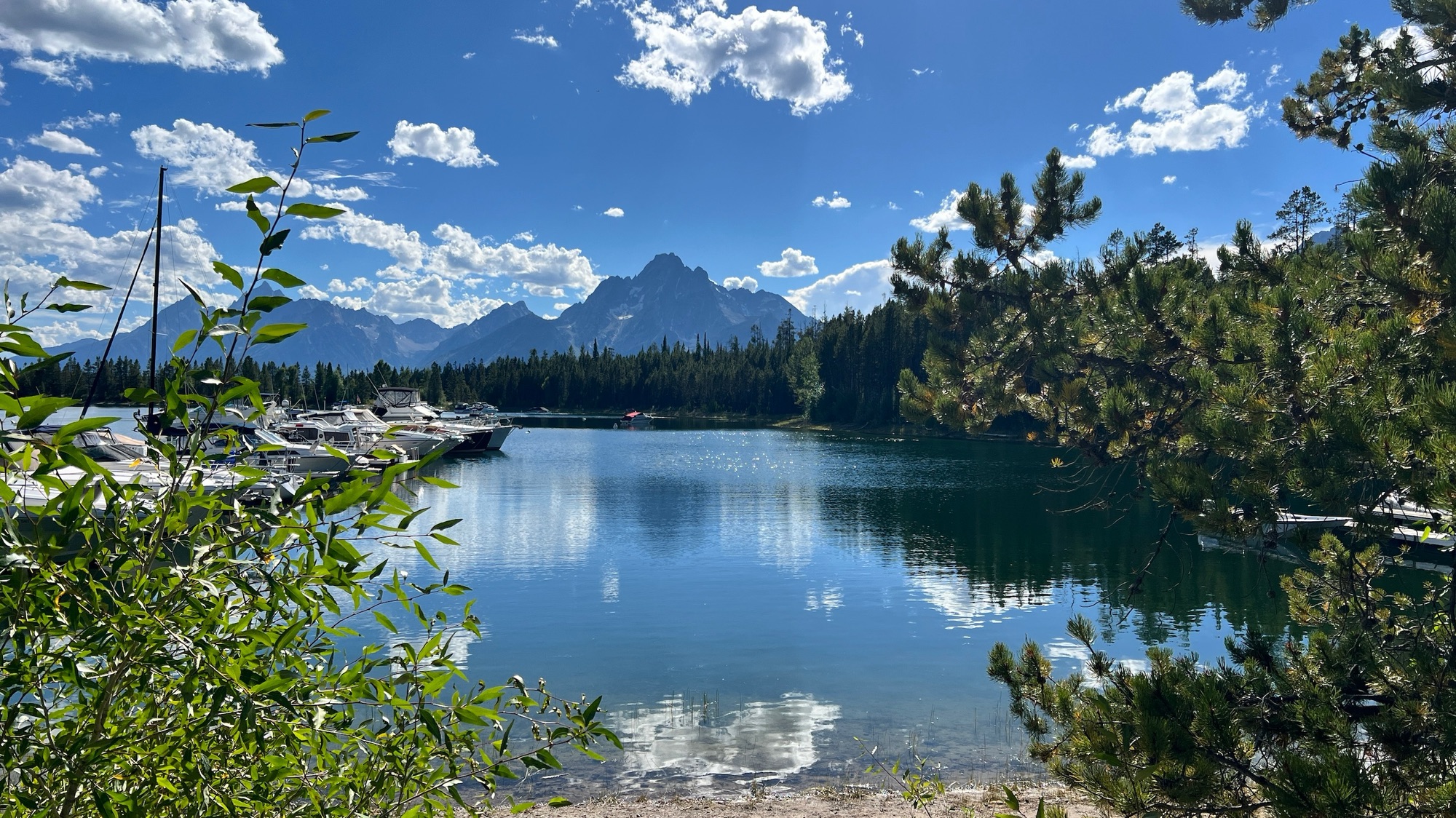
We rented a tandem kayak for the first time and had a beautiful ride around Colter Bay. 
Beautiful day before the smoke from adjacent fires rolled in. 
View from our kayak. 
Lots of wildlife to beware of but we didn’t run across any of these. 
The only moose we saw. 
Terrific trails through the woods 
A little friend… 
Muir’s writings continue to inspire us. 
A bike ride to Jenny Lake
You may have heard of the grizzly bears in Grand Teton NP, especially Grizzly Bear 399 and her four cubs. People approaching bears, and bear acclimating to humans, represent significant threats to both. So much so, that the park has formed a Wildlife Brigade to protect both animals and humans. The New York Times recently published an interesting article about this. While many people visit Grand Teton expressly to see bears, we were very glad not to encounter any bears during our visit.


Fire
In both Yellowstone and Grand Teton, we were struck by the evidence of past fires, as well as signs warning us of active fire zones. Campfires are forbidden in the parks but lightening and Mother Nature are significant sources of fire. My (Sue’s) brother reminds me that as sad as fire damage is, there is a type of pine that won’t release seeds without the extreme heat of a fire: The Knobcone Pine. While we understand and appreciate the need for prescribed fire burning, such large swathes of dead trees spanning acres and acres on both sides of the road, are heartbreaking to see. So far on this trip, we’ve seen evidence of recent fire damage—still smoldering in places—in Guernsey and Yellowstone, WY, and an active fire in Gros Ventre National Forest near Moose, WY (smoke obscuring the Teton Range!). This is in addition to the extensive fire damage we’ve seen in other areas in prior years, especially in California, Oregon and Washington. It will be years before these areas are re-forested.
Evidence of fires in previous years…


Smoke from active fires this year in Wyoming and Utah:


In conclusion, if you plan to visit northwestern Wyoming, be sure to spend time at both Yellowstone and Grand Teton National Parks. Reservations are essential and we understand that by visiting off-season, or heading out early and avoiding the more popular sites, park visitors can experience these two special and most-visited US National Parks without the crowds.
Thanks, as always, for following along.
Leave a Reply