
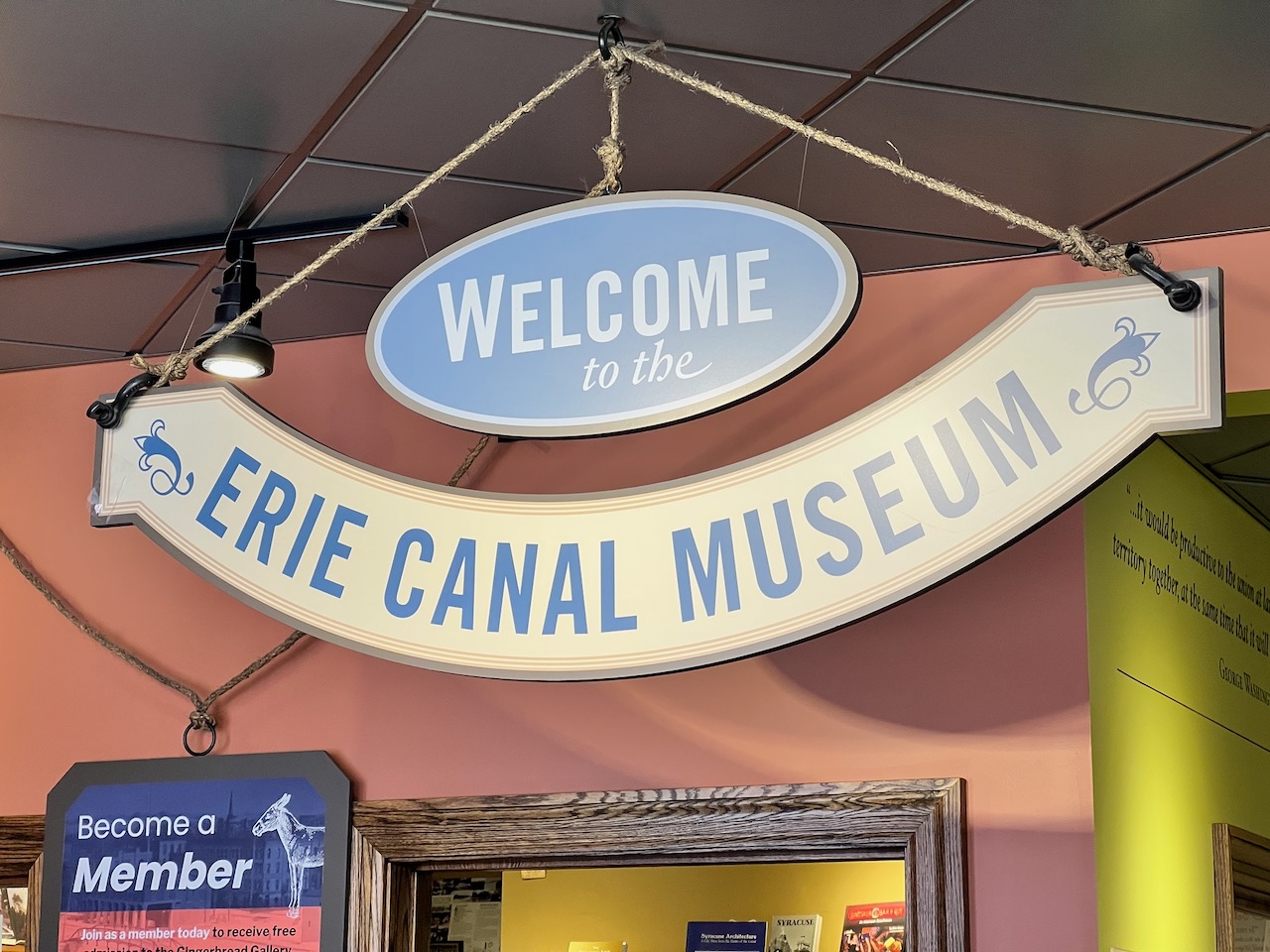
We are heading west toward Pen Yan, NY to spend some time in Keuka Lake State Park and visit a few wineries. Since our route took us close to Syracuse, we decided to visit the Erie Canal Museum and we are glad that we did.
It is difficult to imagine today but in the 1800’s the transportation of people and goods by ground from the east coast to Ohio (considered the western United States that time) was incredibly difficult and expensive. Indeed, the Appalachian Mountains were a barrier to land transit from Maine to Alabama and there were only five locations where mule trails or roads could cross the mountains.

First proposed in 1780s and completed in 1825, the Erie Canal provided a water route connecting the Hudson River to the Great Lakes. The canal was an amazing engineering feat. When first constructed, it was 363 miles long and contained more than 50 locks to allow barges to ascend the 600 feet of elevation between the Hudson River and Lake Erie.
The original canal was built at a cost of 7 million dollars (over 200 million in today’s dollars). What we found fascinating is that canal was not built by the Federal Government but by the State of New York. The Federal Government thought the project too difficult and expensive while New York Governor, Dewitt Clinton (1729-1828) recognized the benefit to both his state and the country. Surprisingly, the cost of construction was paid for with the tolls collected during the canal’s first year of operation in 1826!
The Museum is located in an actual Weighlock Building built in 1850 in Syracuse, NY. This building, and others like it, weighed barges as they traversed the canal and levied tolls based on the weight and type of cargo being transported.

The view from the outside of the Weighlock building. This is the actual location of the building when it was in use. The canal no longer runs through the city of Syracuse.
There is a scale in the bottom of the weighlock building. The barge enters the lock building and the doors close. Water is pumped out of the lock and the barge settles on the scale and weighs the cargo.

The canal was enlarged and deepened three times to accommodate larger boats to permit them to carry more cargo.
While primarily used for cargo, barges on the canal also carried passengers. Many passengers chose to sit atop the barge to enjoy the surroundings. Bridge clearance on the Erie Canal was (and still is) limited and passengers would frequently have to go below deck when passing under a bridge.
This is reflected in of some of the lyrics of the Erie Canal song Sue learned as a child.
Low bridge, everybody down
Low bridge, ’cause we’re comin’ to a town.
And you’ll always know your neighbor,
You’ll always know your pal,
If you’ve ever navigated on the Erie Canal.

The canal slowly was superseded at first the rail road system and finally by trucking transportation. The canal stopped collecting tolls in 1902 and in modern times has become a recreational waterway.
There is ample parking a few blocks from the museum for small class C and B RVs on a public parking lot on 401-13 E Washington St.

Visiting the museum was fun. It left us with a newfound appreciation of the impact of the Canal on westward expansion and of the 19th century New York politicians who made it possible. Thanks for checking in.
Leave a Reply