
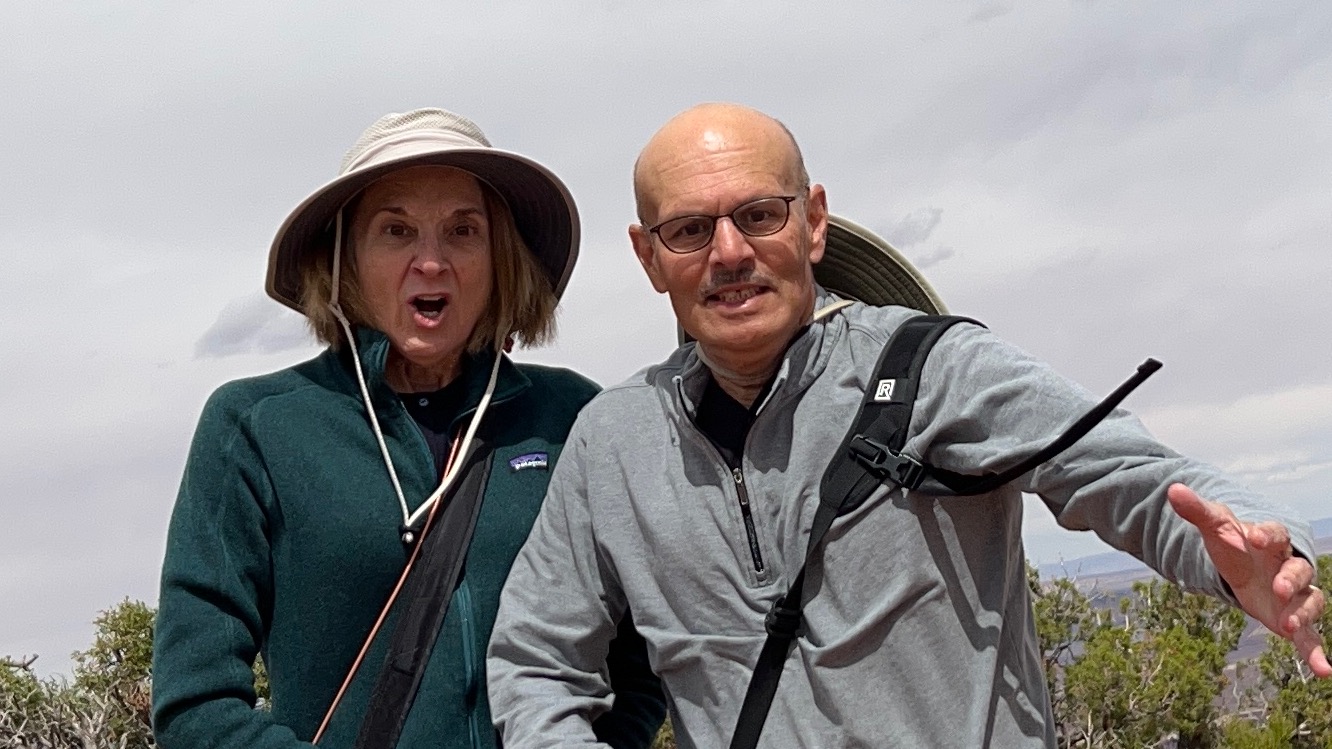
I thought I would write a little about how we visually document the things we see as we travel. I will get to what happened in the feature image above shortly.
In photography “the best camera you have is the one you have with you.” And for most of us, that is our iPhones or another brand of cell phone. Both Sue and I carry iPhones (an iPhone 13 and 12 Pro Max). In addition to the iPhones, I carry a Nikon Z6 with 24-70 f4 and a 70-300 f4-5.6.
The cameras on the iPhones provide a 2X to 3X optical zoom with a 2X digital zoom.) The optical zoom is equivalent to a 13mm to 77mm lens on a full frame digital camera. This is a wider range than the 24-70 f 4 I carry on my Z 6 and the iPhone much smaller and easier to carry.

iPhones use AI to analyze the photos we take and make corrections and improvements to the images’ exposure, sharpness and noise. In many cases there is significant post-process by the phone. In some situations the phone will make corrections to improve the image quality of the faces of individuals. In low-light situations iPhones can do a form of HDR photography, taking individual photos exposing for the shadows, highlights and mid-tones and blending them into a single image so that the overall exposure of the photo is perfect.
There are two situations where iPhones (or for that matter any camera) can’t do well without assistance: position itself for a good selfie post or hold steady for long exposures at night or in dark locations, such as in a cave. This is where a tripod or some other support is helpful.
Every square inch counts when traveling in a Class B RV. Rather than supporting our iPhones with a standard tripod, I purchased a tripod designed for phones called Small rig selfie stick. This $28 tripod/selfie stick collapses into a short 9 inch rod and extends to a full 51 inches. It has a built in Bluetooth remote, however I use the software remote on my watch to activate the iPhone camera.


This selfie stick/tripod has allowed me to get some great shots of Sue and I while visiting various locations and hold the phone steady for low light photos which permits the best HDR image capture.


Unfortunately, the Small rig tripod is not the most stable platform when fully extended. When remotely activated, iPhone cameras collect a burst of 10 shots over a few seconds which are saved as individual photos. This is what my iPhone documented at the top of a ridge in Canyonlands National Park as we posed for the selfie and saw the wind slowly push the tripod over.


Not to worry, the phone survived and we had our photo taken by….a kind stranger who was passing by.
Leave a Reply