
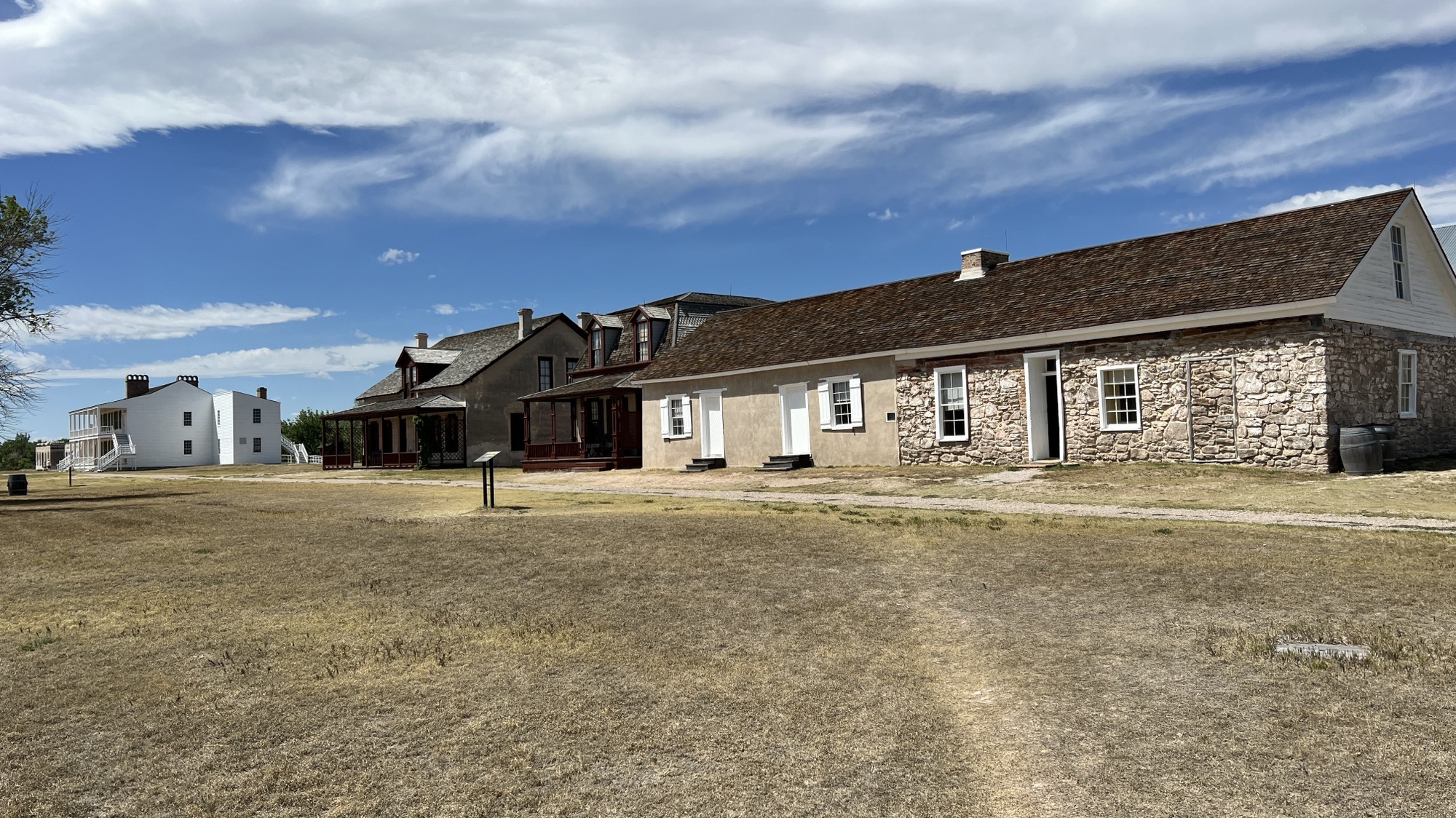
As we travel through the west, we are surrounded by reminders of the world’s largest voluntary emigration, the westward migration along the Oregon Trail. Fort Laramie in Wyoming played an important role supporting the emigration effort.
Fort Laramie began in 1833 as a private trading post, and was first named Fort William. It was build at the confluence of the Laramie and North Platte rivers. The Laramie River had been named for Jacques La Ramie, a fur trapper who visited the area earlier in the 19th century.
Fort William supported the trappers and traders in the fur trade. In 1841, after a competing trading post was built a mile away, Fort William was enlarged to better compete and was renamed Fort John. The US Army bought Fort John in 1849 for $4000 (approximately $164,000 in todays dollars) and renamed it Fort Laramie.
You may wonder why there are no walls around the fort. In its two earlier iterations under private ownership, there was a palisade of logs and finally an adobe wall was built around the fort. When the Army obtained the fort it was not intended to be a defensive structure but a location to provide supplies to emigrants as they traveled west, and to project US military power further west, so no additional walls were built. The original walls no longer exist.
Fort Laramie was an important supply point for emigrants and gold-seekers during the 1849 gold rush. The Fort provided medical, wheelwright and blacksmith services in addition to livestock and food. It was an important resting and restocking stop (one of the few) for emigrants before they faced the long journey over the mountains to their final destinations.


Fort Laramie became the main military outpost on the Northern Plains. Emigrant trails, the Pony Express and transcontinental telegraph all passed through the fort. By the 1850’s, Fort Laramie resupplied 50,000 travelers annually.


By 1889, after completion of the Transcontinental railroad which permitted emigration west without the use of wagons, the importance of the fort had declined and it was abandoned and sold at public auction.


In 1938, less than 50 years after actioning off the property, the Federal Government designated Fort Laramie a National Monument and set about reclaiming the site. In 1960, Congress enlarged Fort Laramie and re-designated it as a National Historic Site. Approximately 11 buildings survived private ownership and are restored to their original condition. The foundations and ruins of another nine buildings are also present. We found Fort Laramie impressive for effectively telling the stories of the many trappers and traders, soldiers and their families, emigrants and Northern Plains Indians who passed through the fort. It was easy to imagine the life on the plains in the mid-19th century.
In the town of Guernsey, which is just a few minutes drive from Fort Laramie, we observed very moving physical evidence of the westward migration: Wagon trail ruts dug into the soft sandstone. The geography of this area required wagons to deviate from the river trail and cross this ridge of sandstone. Nearly all the wagon traffic on the Oregon-California trail traveled this exact route and the ruts are more than five feet deep in some areas.


Fort Laramie National Historic Site, on the eastern approaches to the Rocky Mountains, documents a significant period in American history. The fort reminds us, yet again, of the clashes between the native tribes and people traveling west, and the eventual breaking of treaties by the US government. We were grateful to be reminded of the many people who came before us and the gratitude we owe them.
Leave a Reply