
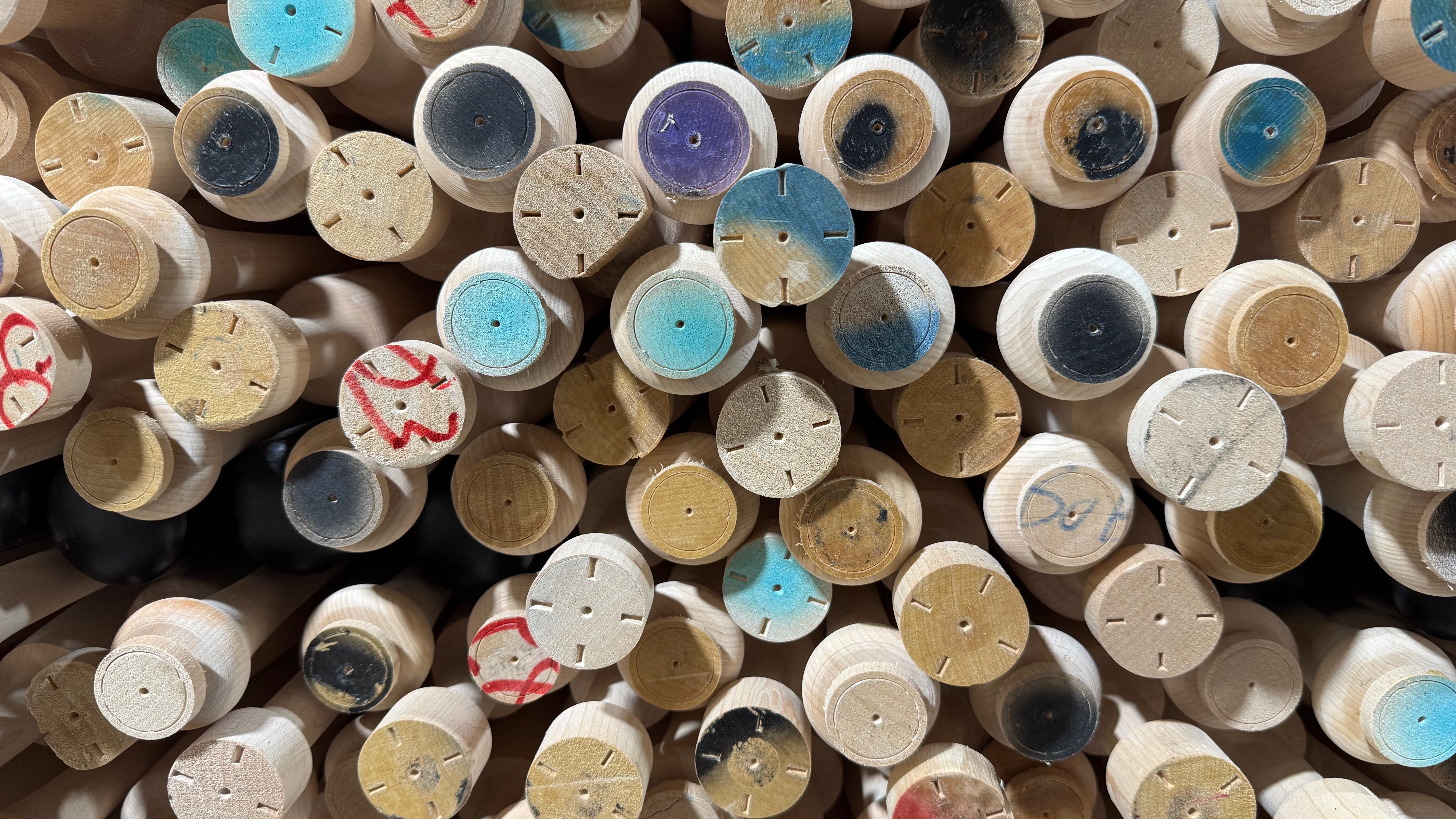
Here it is late February 2026, and we are almost finished writing travel blogs for our 2025 journeys. We have one more location to share after this and updates to a few other posts so the site will not go completely dormant. Since we plan to leave for our first trip of the 2026 season in six weeks, we soon will have lots of new experiences to write about.

If you haven’t guessed by now, we visited the Louisville Slugger Museum & Factory in Louisville, Kentucky. This is the fourth location of the factory, which is located in downtown Louisville and continues to operate today.

In 1856, J. Frederick Hillerich, a German Immigrant, established a woodworking shop in Louisville. Just eight years later, the company became known as J.F. Hillerich, Job Turning. It machined a variety of wood products such as shutters, spindles and interiors for steam ships. Baseball bats were not one of its products. In 1875, Frederick’s son Bud became an apprentice in his father’s business.
It was Bud who made the first bat at J.F. Hillerich, Job Turning. Bud was a big fan of baseball and frequently attended Louisville Eclipse (the local professional team) baseball games. Bud’s father resisted making baseball bats as he did not think there was any money to be made. The origin story on how the first bat made by J.F. Hillerich, Job Turning is a bit muddled. Somehow Bud was approached by Pete Browning, a major league baseball player for the Louisville Eclipse team. Pete was in a batting slump and he asked Bud to make him a new bat. We will never know if it was luck or the new bat, but Pete broke his slump with three hits the first time he used the new bat. After that game, Pete Browning named his bat the “Louisville Slugger”.

It wasn’t until 1894 that the bat business began to grow and “Louisville Slugger” became a registered trademark. J.F. Hillerich and Son was successful but Frederick and Bud lacked the sales and marketing skills to further grow the company. They hired Frank Bradsby, a sales and marketing expert in 1911 to fill that gap. Bradsby eventually became a full parter and the bat making company changed its name to Hillerich & Bradsby Co.

Today, the factory in Louisville makes approximately 1.8 million bats annually, about 3,000 full-sized bats per day. Approximately 75% of pro bats are made from maple wood, 20% are made from birch, and 5% are made from northern white ash from parts of Pennsylvania, New York, and other northeastern states.
Tours are offered every 20 minutes and require tickets. You should definitely pre-purchase tickets as tours do fill up. In addition to the factory tour there are lots of fun and interesting baseball facts and stories in the museum portion of the facility.
You will be walking through a working factory as evidenced by the sound pressure measurements taken by Joe’s iPhone.

Bat making has changed dramatically over the years. At first, each bat was made by hand, manually turned on belt driven lathes. Today computer controlled lathing machines turn out bats in seconds. It’s unfortunate that videography is not permitted on the factory floor. The automated lathes, completely enclosed for safety and to reduce noise, were impressive to watch.


You can pre-order custom bats and collect them when you visit the Museum.

You can choose wood, color of the bat barrel and handle, and even have your corporate logo laser etched into the bat or digitally printed in color! These are not the little league bats of Joe’s youth.

If you visit by car, there is ample street and garage parking all around the factory. RV parking is a little more difficult. We were unable to find any surface parking lots near the museum. We try to avoid parking our RV on busy city streets but we did find a spot to park on West Jefferson street where it crosses S. Roy Wilkins Avenue less than 3 blocks from the museum. Apple Maps erroneously showed a public surface lot at this location but it turned out to be parking for a police station. There were security cameras monitoring the area so we parked there and had no issues. If you are in a bigger rig you will need to do some planning if you choose to park in the city.

Oh, yeah, what about the Bourbon? You can purchase factory tour tickets with a Bourbon sampling! Or, you can skip the factory tour and go straight to Bourbon sampling.
But this is not the Bourbon tour we had intended to focus on. Check in next week when we will take you to Muhlenberg County, down by the Green River where Paradise lay. Confused? Hint: John Prine
As always, we appreciate that you stopped by.

Leave a Reply