
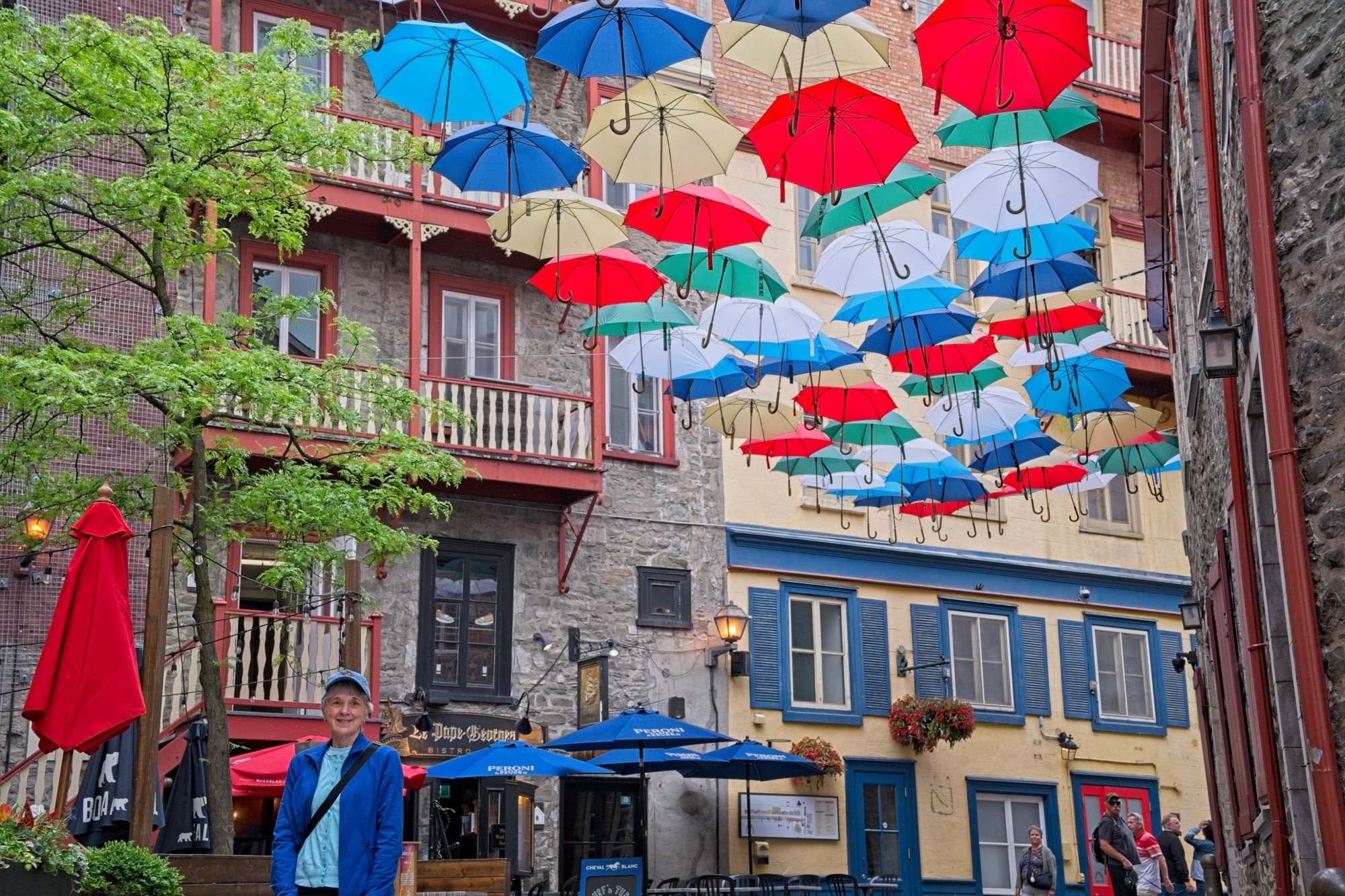
This was our second attempt at “City Touring” in our motorhome. Unlike Montréal, which does not permit any RV parking in public streets, we could have attempted to drive into the city and park. However, we wanted to visit the old part of the city, which has extremely limited parking, so we decided again not to drive. We were fortunate that our campground, a KOA which was 8 miles outside the city, provided a shuttle bus.

Québec City was founded in 1608 by Samuel de Champlain, making it one of the oldest cities in North America. First colonized by the French, the official language of the city and the ethos of the Québec Province remain French. Fortunately for English speaking visitors, 40% of the residents are bilingual.
The old city is made up of two sections, the lower city built along the Saint Lawrence River, and the upper city which is elevated approximately 200 feet above the river. The upper city was fortified by the French, who built walls and other fortifications to defend against British invasion.

In spite of the fortifications, the British did invade in 1759 and their occupation imparted a significant style to the architecture of the city. The city boasts the first Anglican Cathedral located outside of Britain. The cathedral of the Holy Trinity, was built at the direction of and funded by King George. It was completed in 1804.


Much of Québec City’s original architecture reflects a mixture of both French and English and is well preserved and protected by the local government. It is one of the best examples of a fortified colonial city north of Mexico. It was added to the UNESCO World Heritage List in 1985. All this makes for a stunning city to wander through.

Frontenac Hotel upper city 
Streetscape upper city 
Streetscape lower city 
Historical Mural lower city 
Shopping district lower city 
Streetscape upper city 
Frontenac Hotel upper city 
Smith Café Coffee Shop lower city 
Streetscape upper city 
Funicular inclined elevator to upper city 
Looking toward the upper city 
Streetscape upper city 
Mural appears three dimensional 
Streetscape upper city
Early Québec City
In 1639, three Ursuline Sisters, three Augustinian Sisters and six Jesuit Priests sailed up the Saint Lawrence River to settle in New France—now Canada. Over the past nearly four centuries, the Ursuline and Augustinian nuns have gone on to play a significant role in the history of Québec City and Canada. Notably, the Ursuline sisters established North America’s first school for girls, and the Augustinian sisters began a small hospital (the first in North America). The Jesuit College of Quebec was established in 1635 as the first teaching institution in North America, a year before Harvard.
We found our visit to the Ursuline Chapel and the Ursuline Sisters Museum quite fascinating. The Sisters’ education and mission work began the day after their arrival and they went on to educate First Nations girls initially, then girls of French background and even a few English Protestants during the Seven Years War and the British siege of Québec in 1759. In addition to religious studies, the students were taught grammar, literature, arithmetic, geography, history, science (physics, astronomy, botany, chemistry) and the arts (music, drawing, painting and embroidery). We were most impressed with the nuns’ talent and dedication to teaching a wide variety of subjects. The sisters even had a significant gold-leafing practice and provided and maintained the majority of the gold-leaf in the chapel. It’s difficult to overstate the benefit of these sisters to Québec City and the young girls of Québec Province.

The Ursuline Chapel 
Much of the wooden artwork was gilded by the Ursulines between 1736 and 1739 
The coffin of Marie of the Incarnation, OSU, founder of the Ursuline Order in colonial New France. 
Statue of Marie of the Incarnation. 
School entrance 
The museum, which is filled with numerous artifacts. 
Some of the globes that were used to teach geography. 
The last sisters to reside at the monastery.
The Museum was filled with many wondrous artifacts providing a good idea of life spent with the sisters. Included were a series of wooden elevations that provided a terrific view of the evolution of the Ursuline campus.


For nearly four centuries, the Augustinian Sisters cared for the sick and vulnerable in the territory and over time they created twelve monastery-hospitals across Québec. The nuns still have an excellent reputation for healing and wound care. We did not have time to visit the Augustinian Sisters Museum, or stay overnight in Le Monastèredes Augustines, but hope to do so on a future visit.
All three orders managed to survive and rebound from numerous challenges, including but not limited to wars, bombings, infectious diseases, fires, and city politics. We have a newfound appreciation for the small party of six nuns who arrived here nearly four centuries ago, and their many contributions to this amazing city.
The Port of Québec
The port initially supported the fur trade but later became a major hub for timber exports, shipbuilding, and transatlantic immigration. In the 19th Century, with the evolution of ship technology and the advent of steam ships allowing for travel further up the St. Lawrence River, the shipping trade moved to Montréal. Québec City continues to be an important port for cruise traffic and as a key link in global supply chains, including connecting the Great Lakes and Midwestern US to global markets.
We had such a great time sightseeing and shopping that we are certain to return to Québec City someday!
If you RV to Québec City we highly recommend the KOA which is just 20 minutes from the old city. This KOA is one of the nicest campgrounds we have visited. Nice pool, clean showers and laundry. While we choose to take the KOA shuttle into town ($15 Canadian), bus service is available near the KOA or one can drive and park RVs just outside the city and take a bus. There are many nice hotels in the upper city for Non-RVers.


Leave a Reply to ontour2.2Cancel reply